The U.S. leads the world in data centers — and nearly half of new ones are headed to the South. Here’s what to know.
As data centers continue to emerge in Tennessee, here’s your guide on what they are, where they are and why they continue to be a major talking point.
NASHVILLE, Tenn. (WSMV) - As data centers continue to pop up across the nation, there is one area that accounts for nearly half of the thousands of planned constructions — the South.
Thousands of data centers already exist in the U.S., although the exact number differs among researchers. According to researchers at Statista, the U.S. leads the world in the overall number, with nearly 4,200 data centers as of April 14. The nation with the second-highest number is the United Kingdom, with 515 centers. China ranks fourth, with 369 centers.
Around the same time as that data was released by Statista, analysts at Pew Research found that the U.S. has more than 3,000 operational data centers, with more than 1,500 “in various stages of development.”
But what exactly are data centers, what do they have to do with AI and why are they such a big deal in Tennessee? Here’s everything you need to know.
What is a data center?
As explained by McKenna Beck, a Ralph Cavanagh Climate Solutions Fellow at the Natural Resources Defense Council, data centers “have been around forever.”
“They are essentially just massive warehouses filled with rows and rows of computer servers that require both power and water to operate,” she told WSMV. “...What’s different now, is with the development of artificial intelligence technologies, there has been a huge boom in data center development.”
The World Resources Institute describes these facilities as “the physical infrastructure of the internet.”
“They house the servers, networking equipment and supporting systems — such as cooling, power backup, fire suppression and security — that keep digital services running reliably," the institute says. “...These facilities can take many forms, ranging from small server rooms inside of office buildings to massive, stand-alone campuses the size of hundreds of football fields.”
While data centers are traditionally used to manage basic internet traffic, NRDC Director of State Power Sector Policy Jackson Morris told WSMV that today, they’re used for everything from internet traffic to health care data storage to entertainment. Most recently, data centers have been built to handle AI functions, and these are the facilities that seem to cause the most controversy.
“These are not your father’s or mother’s data centers,” Morris said. “...Everybody that streams Netflix is streaming it through a data center. ...These things are being utilized by almost everybody, unless you like literally live off the grid.”
Where are data centers in the U.S.?
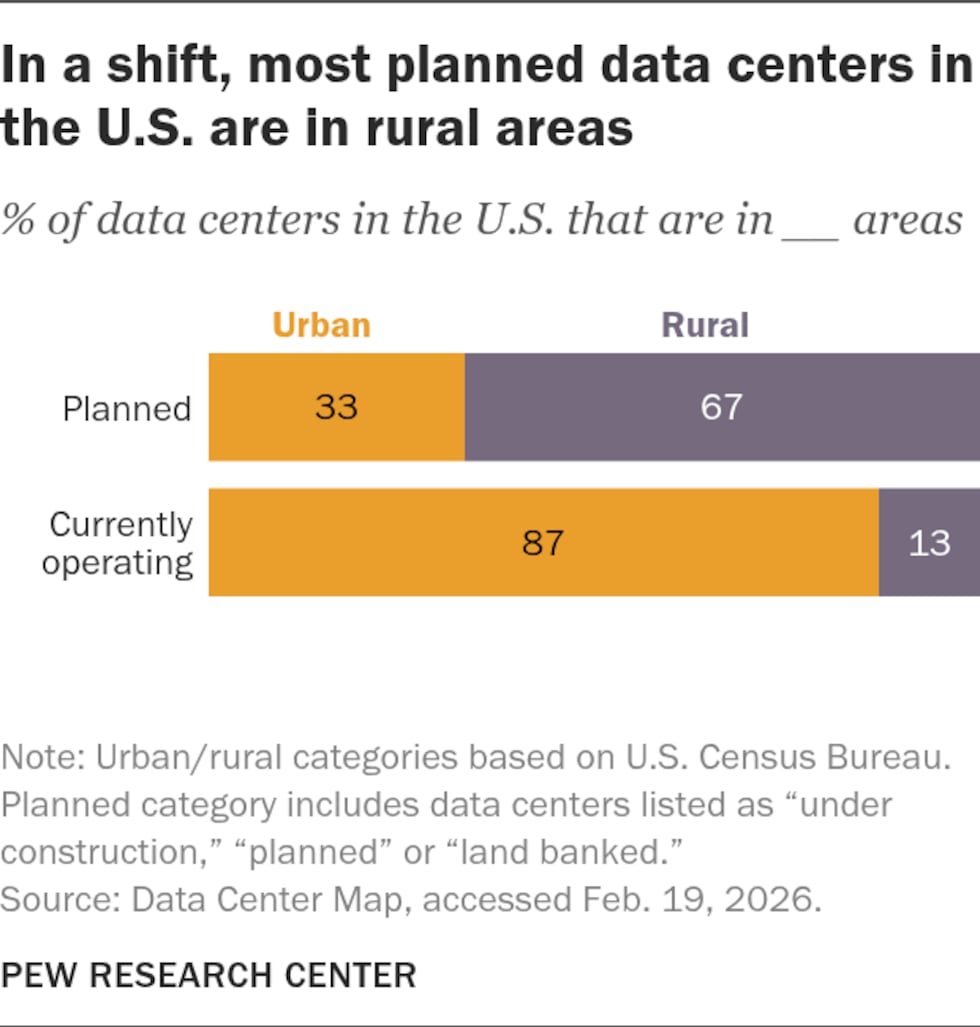
Pew researchers found that nearly 90% of the data centers that already operate are in urban areas. But of the more than 1,500 planned data centers nationwide, 67% are in rural areas. They also found that 39% of planned data centers will be located in counties that don’t have any such facilities.
And three-quarters of those new developments are set for two regions, the Midwest and the South, the latter of which will account for nearly half of all new constructions.
Researchers found that the South is expecting 62% increase in the total number of data centers, most of which will be in Virginia and Texas.
Where are data centers in Nashville?
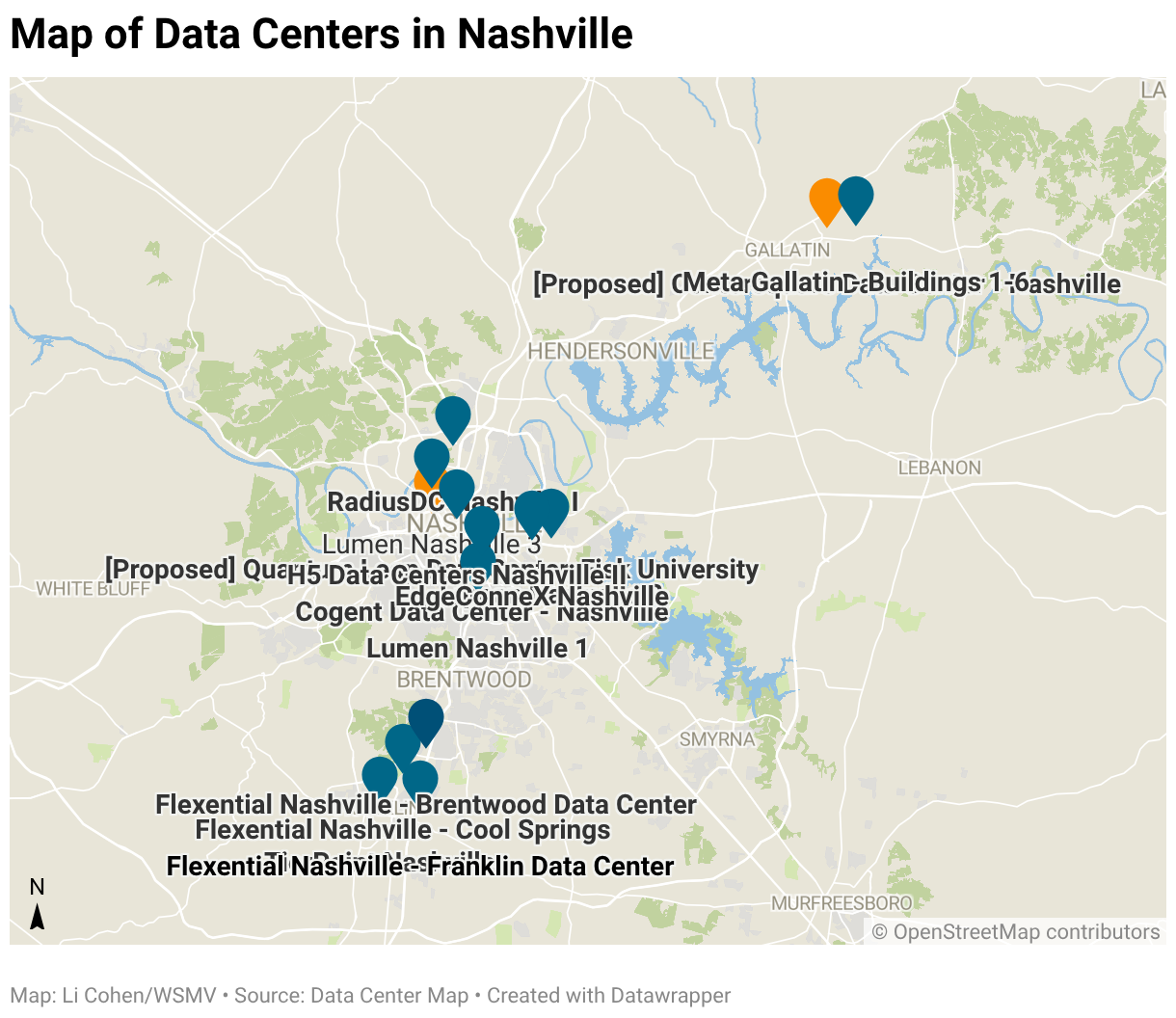
WSMV is in the process of tracking data center locations, their size and their power usage. So far, we have been able to confirm at least a dozen data centers in the Nashville area — including Meta’s campus in Gallatin.
Meta’s campus is by far the largest, with a power capacity of 300 megawatts. The second-largest data center confirmed thus far is a 20-megawatt facility owned by RadiusDC.
There are also at least two data center sites seeking approval in the area — a 30MW facility at Fisk University, and two buildings — one with a power capacity of 10MW and the other 40MW — next to the Nashville Zoo.
WSMV is working to confirm locations of additional sites and proposals as they arise.
What is an AI data center? Are there different types?
While AI data centers are the most thought-of facilities, they are actually just one type. Technology company Cisco Systems describes six categories of these facilities:
AI data centers
These sites are specifically made to support artificial intelligence, like ChatGPT, Claude and Gemini. These are the facilities requiring more advanced infrastructure to function, and what are typically affiliated with the larger environmental toll.
Enterprise data centers
These facilities are owned and operated by a company and tend to be located on corporate campuses for internal use.
Managed services data centers
These centers are managed by a third party.
Colocation data centers
Colocation centers are spaces rented by businesses to house their own servers and data storage equipment.
Cloud data centers
These facilities are managed by a cloud services provider like Amazon Web Services, Google Cloud Platform, Microsoft or IBM Cloud. These spaces allow businesses to store their data remotely, rather than on-site at their own facilities.
Edge data centers
The company FiberLight compares the function of these data centers to that of a local post office, explaining that they’re “smaller, localized” facilities that process and store data closer to where devices are used. Doing that, the company says, helps reduce the “reliance on massive, centralized data centers in major metropolitan areas.”
Other types and terms
There are various terms used to describe these facilities. You’ve likely heard of “hyperscale data centers,” as well. These sites, according to Pew Research, are facilities typically with thousands of servers in facilities that could get up to hundreds of thousands square feet.
How much energy do data centers use?
Just three years ago, the U.S. Department of Energy found that data centers as a whole accounted for 4% of total U.S. energy consumption. By 2030 — just 3-and-a-half years away — that demand is expected to rise to 9%.
In January, the U.S. Energy Information Administration issued a report showing that data centers are fueling the projected growth in electricity demand.
Energy and water consumption greatly differ between facilities. Smaller facilities that are used more for a smaller company’s data storage needs will require less servers, less energy and less water. Hyperscale facilities or those that run AI tools, on the other hand, require substantially more servers, and therefore more water and more energy.
There are no official guidelines or definitions for what constitutes the sizing of a data center, but IBM says that there are four general understandings of their sizing and how it relates to their energy consumption:
Micro data centers: These facilities are typically less than 5,000 square feet and use under 150kW of power. They typically have about 140 servers.
Small data centers: These facilities usually occupy anywhere between 5,000 and 20,000 square feet and require 1 to 5MW of power. They typically have between 500 and 2,000 servers.
Average data centers: The sizing of these centers could range between 20,000 and 100,000 square feet and require about 100MW of power. They typically have between 2,000 and 5,000 servers.
Hyperscale data centers: The largest on the scale, these facilities generally have at least 5,000 servers, occupy at least 100,000 square feet and require over 100MW of power.
Most of the data centers in Nashville that WSMV4 has confirmed require 6MW or less of power. The only exceptions so far are a Radius DC center, which has a power capacity of 20MW and is at 102,500 square feet, and the Meta campus in Gallatin, which measures at 1.7 million square feet.

What are the environmental concerns about data centers?
Data center controversies tend to settle around four main points: Water usage, electricity demand, pollution and climate change.
A United Nations report on the environmental cost of AI’s energy consumption found that in 2025, data centers worldwide consumed about 448 terrawatt hours of electricity.
“If data centers were a country, that level of electricity use would rank it 11th globally,” the report says. “On current trajectories, data center electricity demand could roughly double to 945 TWh by 2030, nearly triple the combined annual electricity use of Pakistan, Bangladesh, and Nigeria, together home to more than 650 million people.”
McKenna Beck of the Natural Resources Defense Council said it plainly: “Data centers are driving, essentially, like a revolution of the natural gas industry.”
That energy consumption is known to drive up prices for consumers and strain power grids, especially as human-caused climate change causes more frequent and intense incidents of extreme heat and extreme weather that already put a strain on energy infrastructure.
But it’s not just the energy use that is of concern to communities and experts alike — it’s also that data centers require a lot of water in order to keep their servers cool so that they can properly function.
The World Resources Institute reports that mid-sized facilities could require 300,000 gallons of water every day, with larger facilities requiring as much as 5 million gallons of water a day.
“Recent estimates project that by 2028, AI-related data centers in the U.S. could require up to 32 billion gallons of water annually,” WRI says. “This is enough to support roughly 360,000 households’ indoor water use.”
As far as pollution, many communities express concern from one, the actual construction process of larger data centers, and two, air pollution once they go into operation.
This became a palpable problem in Memphis when Elon Musk’s xAI’s Colossus data center implemented more than two dozen natural gas turbines on its property. There are also concerns that on-site gas power and the diesel-fueled backup generators many facilities have can contribute to air pollution and worsen air quality.
The construction and rooftop cooling systems with these facilities are known to be noisy as well, and there are instances where data centers have caused notable disruptions in communities, according to WRI.
How do I find data centers near me?
Sites like Data Center Map provide a general overview of where data centers have been reported in areas, but not all of its listings are accurate and do require further research.
WSMV is working to confirm the locations of data centers across Middle Tennessee.
Click HERE for a list and map of data centers in the Nashville area that WSMV has confirmed, and visit wsmv.com/news/investigate/data-centers/ for our ongoing coverage.
Copyright 2026 WSMV. All rights reserved.